Peatlands Hydrology II
Synopsis
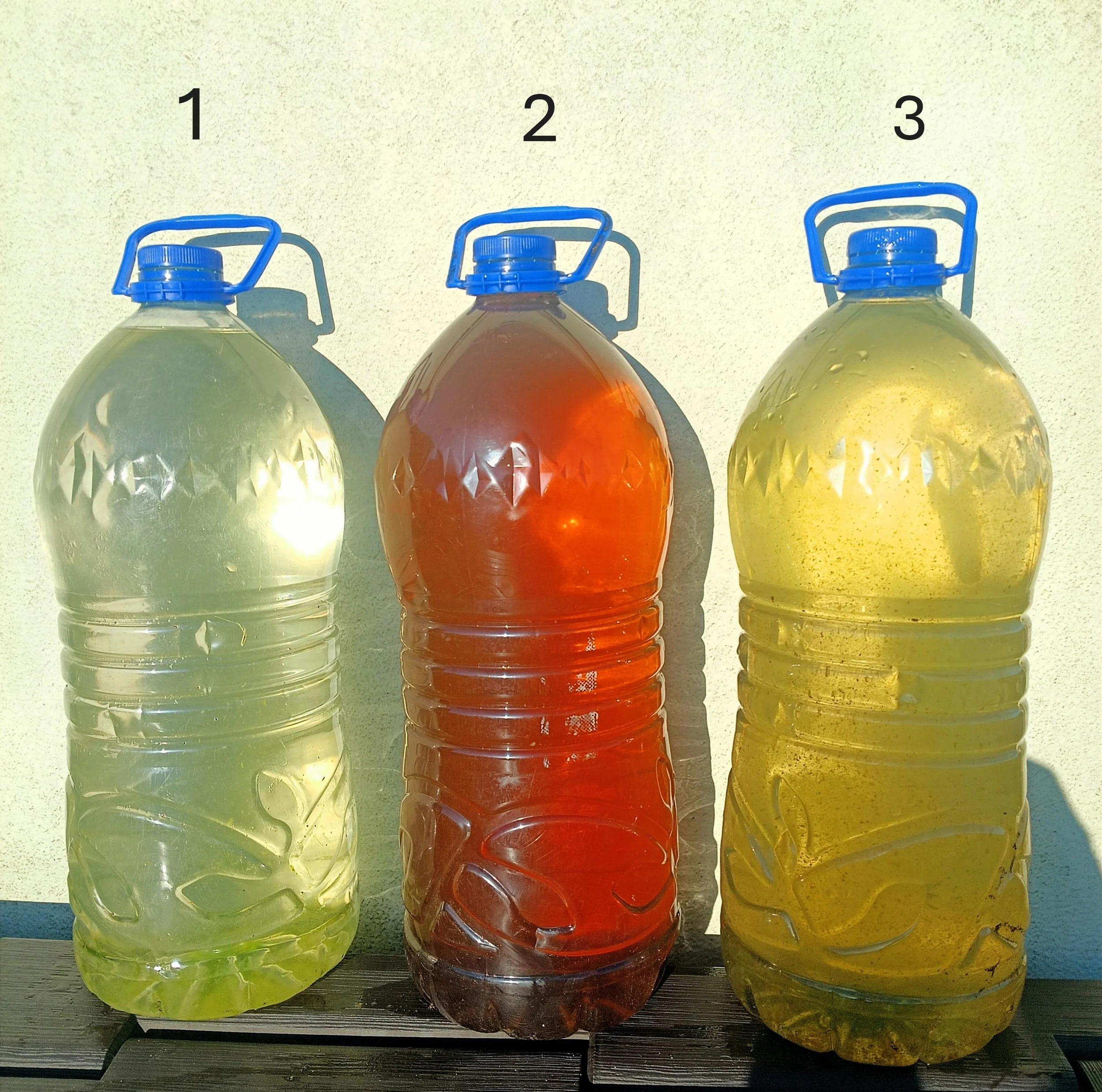
Please consider the picture.
Bottle 1 – untreated rainwater. Not too bad in Boleysillagh. We have been drinking it every day for the past 6 years!
Bottle 2 – Bog water run-off (shades of brown because of what is commonly called dissolved organic matter (DOM)). Exposure to sunlight bleaches it and any organic matter dissolved in it. This then releases CO2 – again, opposite of what we are trying to achieve. This happens even when the water is sealed in a plastic bottle. More on this later below.
Bottle 3 – Bog water exposed to the sun for 6 months in the summer – damage is done.
Bottle 2 water is typical of bog water, the distinctive brown colour being due to natural organic acids like humic and fulvic which are the result of decomposition of peat forming vegetation like Sphagnum moss, rushes, heathers, bog cotton, sedges and grasses like molinia caerulea (purple moor grass). Purple moor grass is deciduous, i.e., leaves die off each winter and they form clumps like habit. It is a precursor to ornamental grasses we buy in garden centres.
NOTE: If a bog has many of the above vegetation, chances are the bog may be not too far gone yet for restoration.
The decomposition of these plants still requires a small amount of oxygen. Every plant matter requires oxygen, so the question is how much or how little. The form of decomposition in peatlands and some wetlands is governed by heterotrophic processes as opposed to autotrophic processes. With very little oxygen, waterlogged conditions, and the creation of acidity every time it rains (simplified meaning - vegetation like peat moss reacts and undergoes ion exchange with its surroundings, releasing hydrogen into the water), only certain types of vegetation can survive in the bog. The rate of decomposition is extremely slow due to environmental conditions such as temperature, water volume, sunlight exposure, and the type of vegetation, including moss, rushes, or other types. There is a slight problem – too much decomposition too quickly can result in the opposite reaction: an increase in CO2 production. This happens quite often here at Boleysillagh Farm, especially during the hot summer months when the water table is 3 inches lower than it would normally be. More on fluctuating water table and surface water later.
In terms of practicality, for example, it takes between one and two years for the purple moor grass (due to its high lignin and carbon-nitrogen ratio) to decompose, so each winter we rake it off and mulch our fruit trees. We then cover with other non-peat-forming vegetation from our cattle farming neighbours, especially their first cut of silage.
For our agroforestry project, whatever mulch and other organic biomass we add, we ensure that no substance undergoes a rapid rate of decomposition. We do not use woodchips for example – we use tree branches, logs and other biomass that takes a relatively long time to decompose instead. Nothing is buried in the bog and absolutely no digging.
When the bog water run-off eventually meets water courses, streams, ponds and rivers, carrying all these chemicals and microbes, the environmental damage to other vegetation, wildlife, especially aquatic, cannot be underestimated. When the water companies pump the water which comes from upland catchments, generally for our consumption, various treatments have to be done for our health and safety. Regrettably, compounds like chlorine mix with the water, which is already contaminated with bog water, resulting in various chemical reactions leading to the production of things like methane gas. That basically is what we smell when we walk around bogs or when we are cutting, turning and footing turf every year.
NOTE: Check what type of bog you have when it comes to water – is the bog solely fed by rainwater, or is there groundwater seeping up from somewhere? Or even perhaps your bog is being fed by drains from neighbouring bogs, especially uplands. It all matters when it comes to assessing the viability of restoring bogs. Rainwater can make the bog acidic because of microbes and other chemical reactions.
One counter-intuitive fact – Once the bog is deemed suitable for restoration, the blocking of drains, building berms and swales to block off water run-off, agreement with neighbouring farms, etc., what other factors must be taken into account?
The first factor is how much water. If the bog is purely rain-fed, then how much of that rainwater must one keep back from leaching away? Too little is no good, especially in the summer months when the surface water level drops off sometimes by 3- 6 inches, leaving the top layer of the surface exposed to oxidise. This process is not reversible. If too much water is kept, it adds problems with vegetation and gases such as methane become a problem. It is a much bigger problem than CO2. When the bog is seriously re-wetted, which results in waterlogging, oxygen for aerobic reaction is no longer possible. Instead, anaerobic reaction takes place, which results in methane being produced. The end result is a bog that not only does not sequester CO2 but actively produces a much more Dangerous methane, CH4. Just great, isn’t it? So, how much water is ideal?
Basically, waterlogging during winter months when temperatures are ‘cool’ does not appear to cause too much damage. In the spring and summer however, and even during the autumn, the temperatures are still too warm. The drying action is too dangerous because it leads to ‘hot’ bogs prone to fires, etc., and it is also during such times that rainfall can dramatically drop. Here in Boleysillagh, there are months when no rain falls. So it is hard to say what an ideal level of water should be. It is site-specific, and many factors can affect that calculation. Academic studies do suggest that the water level should be kept within 1” of the surface level at all times. That’s a hard one.
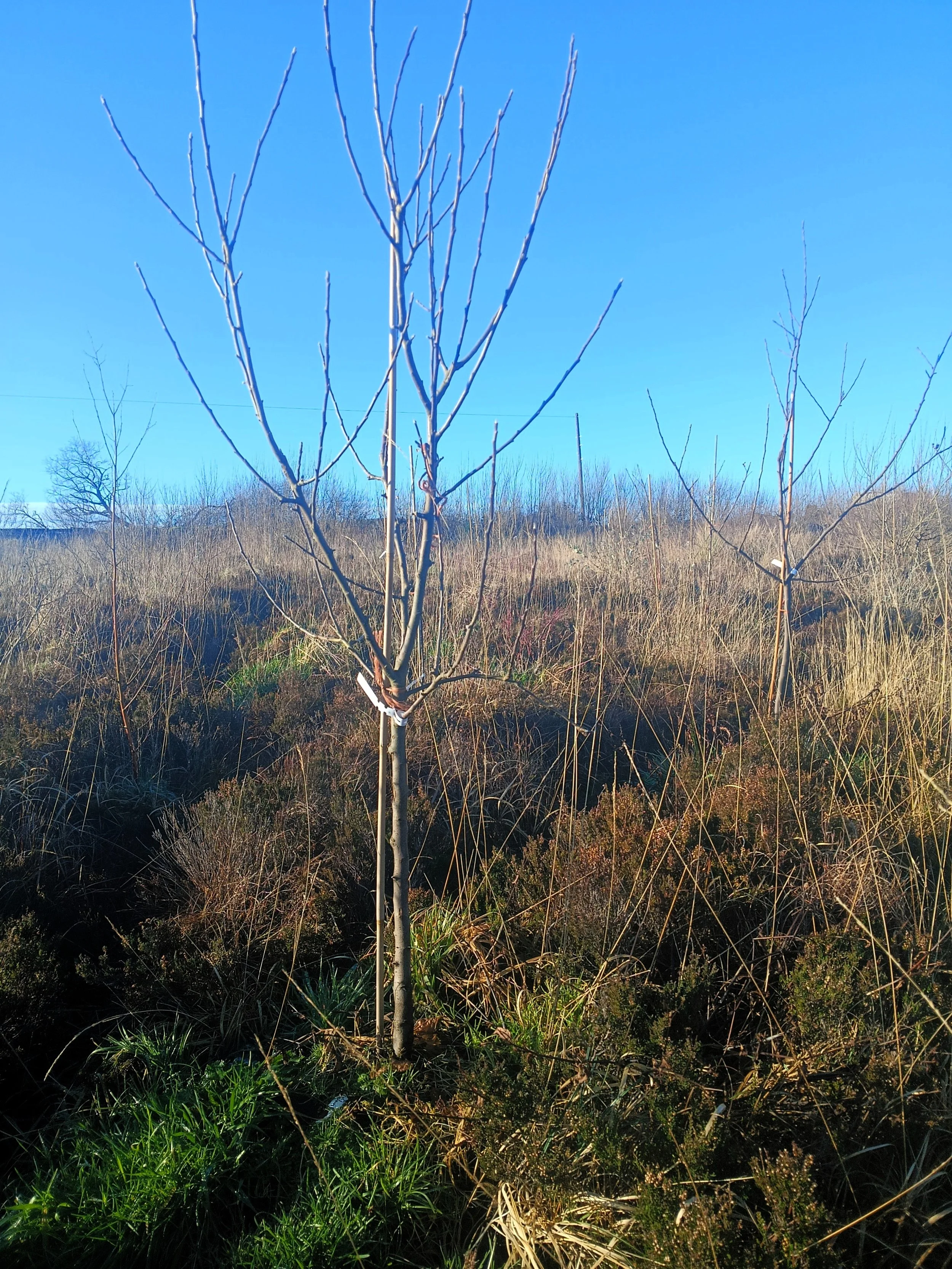
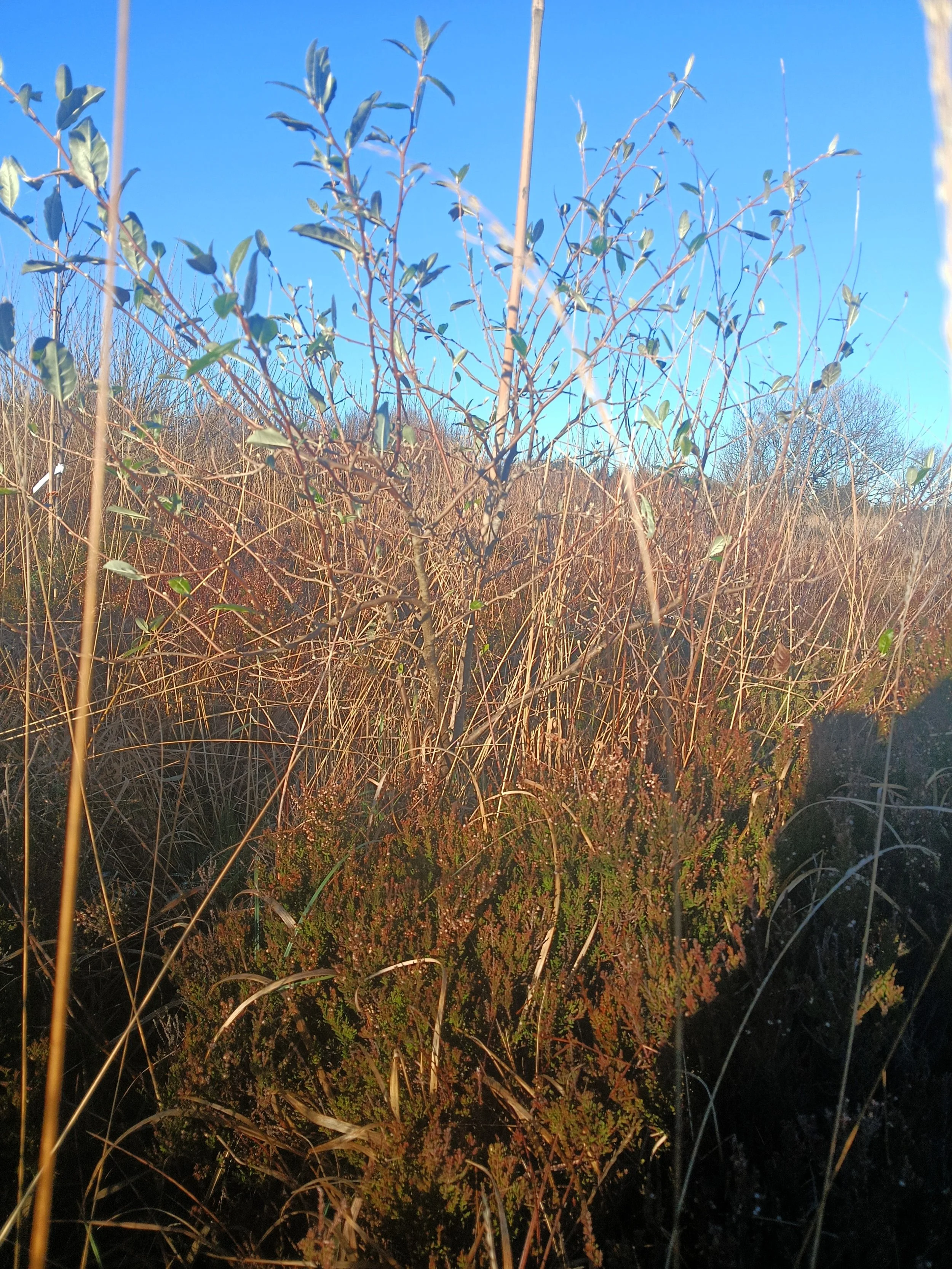
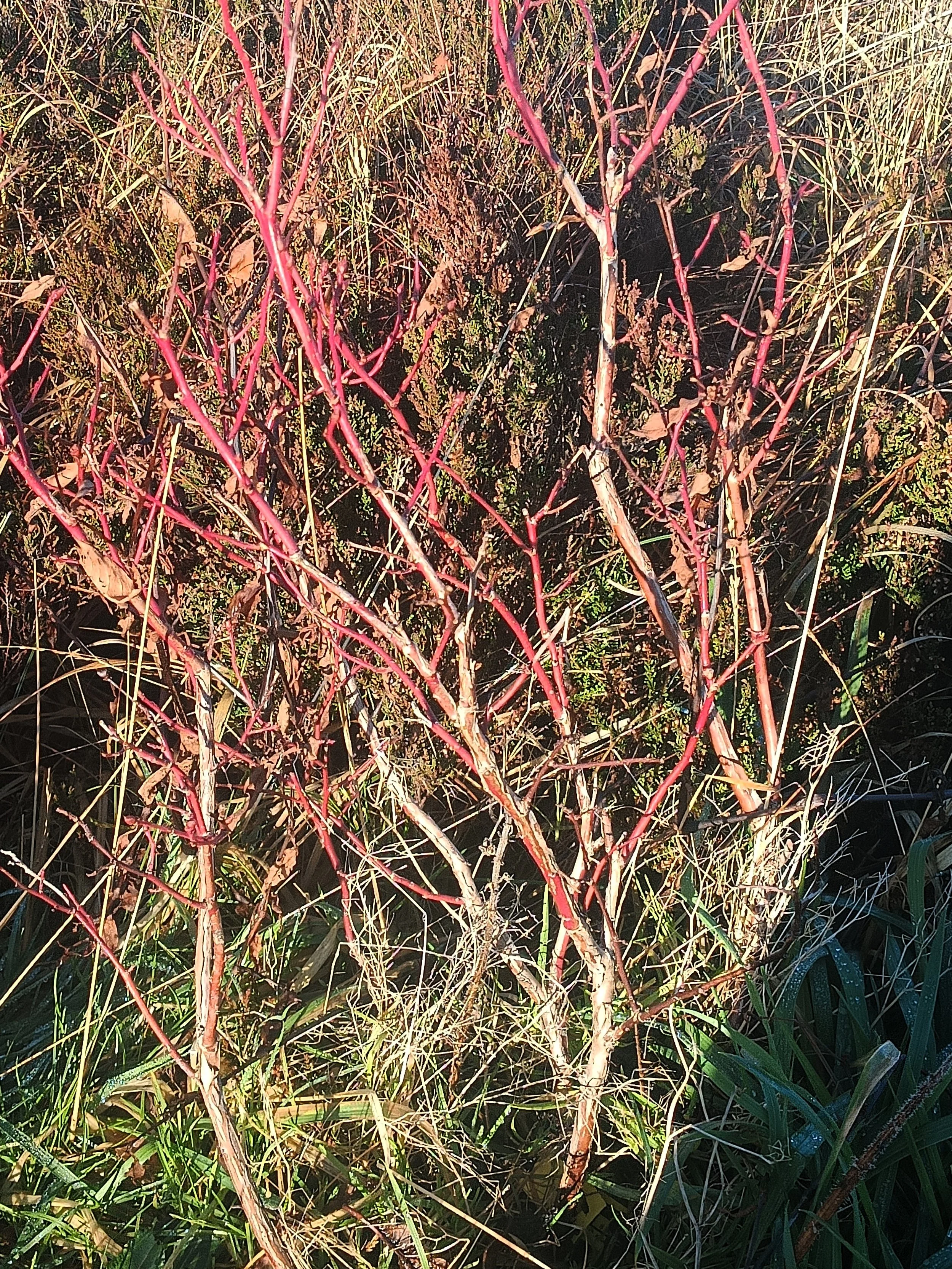
We have an added challenge with the agroforestry approach. Agroforestry means trees. A large number of trees, including fruits and nuts. Trees like alder, for example, require a lot of water. They also require a large amount of Magnesium and Calcium. Simply put, most rain-fed blanket bogs do not have much of these and what little it possesses, peat moss converts Magnesium and Calcium into Hydrogen ions to make the bogs acidic. This further prevents many plants from taking up these nutrients which most plants need for nutrients and photosynthesis. Some plants however, such as Vaccinium corymbosum (blueberry v. ‘chandler’) (pic) only requires a minute amount of Magnesium and Calcium hence they do well in acidic bogs. Others such as Malus Domestica (apple v. Widow’s Friend) (pic) require a carefully controlled balance between Magnesium and Calcium. We will explore these in our paludiculture section in detail.
So for us, the only option seems, at least for now, to keep the bog literally water-logged as close to the surface as possible. That way, any seasonal variation, temperature and fluctuating water table, at least in theory, would not be too detrimental to bog restoration and keep the trees alive at the same time. To keep bogs from getting ‘hot’, we ensure that no surface is left bare. We leave any and all vegetation as it is. It is a challenge, and the results are not entirely in. We are still at the data collection and analysis stage and trying out a few practical solutions. Ultimately, only time will tell.
So the unpalatable truth – re-wetting will not bear fruit in terms of sequestering CO2, at least for a decade or so. Some studies suggest 50-odd years. Not something one would read from mainstream media. For a while, the re wetted bogs WILL undoubtedly be releasing much more dangerous methane CH4 gas! As for measuring the success and failure of bog restoration, that is still up for debate. One can now see the current thinking which relies not only on bog restoration but on BOG REHABILITATION into wetlands, nature conservation areas and public amenity and leisure spaces for the community as well as wildlife ecology.
This was the fundamental reason why we sought to restore our bog through permaculture-based agroforestry here at Boleysillagh Farm in 2019. Over the past 6 years, we have found the paludiculture and agroforestry routes being explored more and more by large, well-funded operators with the backing of the Irish government and the EU, with trials and research grants. We, of course, remain rooted in the small-scale micro-farming community on the side of ordinary farmers going about their daily lives doing extraordinary things, through practical, down-to-earth means.